Home / Work / byu-flagellar-motors
Locating Bacterial Flagellar Motors
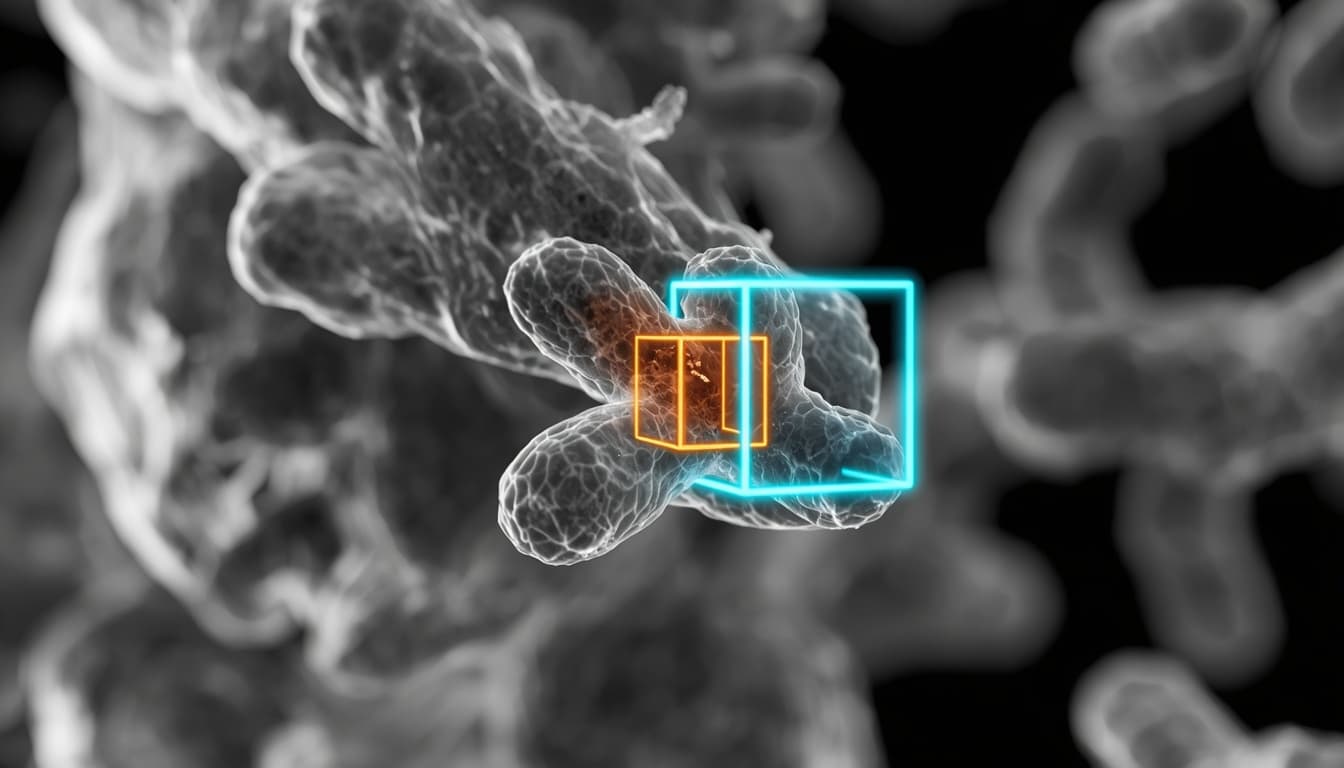
3D Object Detection in Cryo-Electron Tomography
Problem
Flagellar motors are tiny, sparse, and buried in noisy cryo-ET volumes. Manual annotation is slow and inconsistent — and a structural biologist will only trust a detector with near-perfect precision.
Approach
Compared three families of detectors on the same tomographic dataset. Anchor-based (Faster R-CNN), anchor-free (CenterNet), and a modern one-stage detector (YOLOv10). To isolate which inductive biases hold up under cryo-ET noise.
Tuned input resolution, augmentation, and post-processing per architecture rather than using off-the-shelf defaults, because cryo-ET slices look nothing like natural images and standard augmentations actively hurt performance.
Containerized the full pipeline and ran training on AWS GPU instances, so the entire experiment is reproducible from a single Docker image and a config file.
Results
mAP@50 = 0.948 · Precision = 1.00
- mAP@50 = 0.948 on held-out tomograms
- Precision = 1.00 — zero false positives at the operating threshold
- Three architectures benchmarked under identical preprocessing
- Reproducible: Dockerized, AWS-ready, single-config re-run
Stack
What I learned
On scientific imaging, architecture matters less than calibrating the precision/recall trade-off to what the downstream user actually trusts. A biologist will use a detector with perfect precision and missing recall; they won't use one with 0.95 precision no matter how high the recall climbs.